
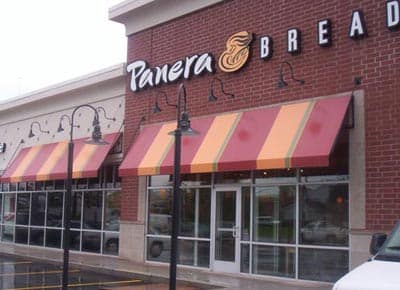
We all know that awnings are an economical and efficient way to shade a deck or patio from the hot glaring sun or cold winds and rain. In the old days (meaning if you’re over 40 and somewhere before 1960), awnings were used to keep a building shielded from the sun. These were folded up in the winter time to use the sun’s rays for heat.
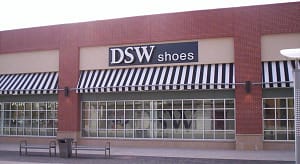
Today, although awnings still provide protection from the elements, they are used to carry a message. Typically they’ll advertise the building name and/or communicate a name brand to let visitors know what is inside the building.
The business of awnings
 Often viewed as a minor segment of the sign industry, the awning segment provides opportunities for the sign professional to meet a customer’s needs on many levels. Awning design and installation of yesteryear is now in need of repair and the business of retrofitting and refurbishing is looking very bright. “The rebuild and repair business is very busy,” notes Chris Reber, Vice President of Illuminated Image. “There are a lot of awning designs out there that were made with aluminum frames. This makes the recover business a little easier because the solid structure is still there.”
Although many awnings were installed with quality products at their time of manufacture, variables like age, weathering, and new technologies have invigorated the demand for rehabbing existing awnings. Mike Tarak of Awning Partners has found that many of their customers are seeking new styles with improved materials for refurbishing their awnings. “We are finding that one of the reasons for rebuilding is to change to newer materials. We find that some customers prefer getting away from the grommet style and going to the staple-end method of awnings,” says Tarak. “The cost of production is much less, so from a labor standpoint the customer is getting a top-notch product at a bargain price.”
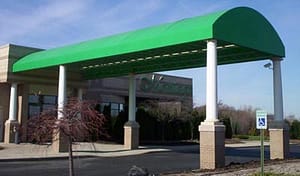 In addition to simply recovering older awning designs, many customers are seeking to change the old style to a new architectural design that reflects their business image as well as to flow with the new building designs and the city landscape. Peter Burnett of the Cooley Group, Sign and Awning Products division, has seen a significant amount of retrofit business due to the hurricanes these past couple of years, particularly in Florida. “We see folks buying large quantities of our new Weathertyte material for refurbishing existing structures in Florida. This increase in business is not only for replacing the damaged material, but we are also seeing people using the damage as a reason to redesign their awnings.”
Obviously, with all of the existing awnings come opportunities for repairing, refurbishing and redesigning awnings and awning signs.
Keeping up with trends
A smart player in the awning installation business will learn about all the new architectural styles, designs and innovations that exist today. He or she will seek and find new and better products to offer their customers. “With all of the new inks, printers and top coats that keep coming out, as well as the new creative digitally printed designs, there are more opportunities for the sign professional in this changing market,” says Burnett. “We are seeing a huge response to the new high performance composites because people want a new creative look, but with increased performance.”
 Along with the traditional backlit awnings, many awning companies are now offering front-lit designs. Changing it up a bit is the key to being able to get in on the increasing demand for sign awnings. Some municipalities are not as strict regarding permitting for awnings and often only require that the designs keep in line with the parameters of the city architecture.
Chris Reber is finding that more customers are leaning toward more creative architectural designs than before. “The trend is more of a flip-flop effect. It used to be that most of the business was with illuminated awnings and that is where the priority was. Now, we are finding more customers desiring more architectural designs that will set them apart.” With this knowledge, a company can get ahead of the game by either hiring some creative designers or simply going out and finding cool designs that might appeal to customers.
Mike Tarak agrees, “We’ve had success with our architectural designs. It is simply just a matter of giving the customer what they want. Sometimes that requires educating them and having examples of previous jobs to show them.”
Getting on board
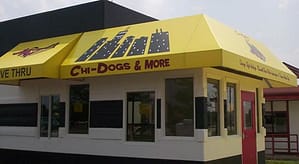 For the sign professional new to the awning business, getting started is not as hard as you might think. Businesses like Awning Partners offer a turnkey solution. “Once the sign professional has the dimensions, they can just send us the specs and we’ll either provide just the materials or provide the materials and take care of the installation. We can act as a revenue center for them.”
Burnett of Cooley suggests that you really do your homework before getting started. “It takes some time and knowledge, but someone already in the sign profession can offer sign awnings as part of their overall package, but they shouldn’t underestimate what is involved. Taking time to learn this end of the trade can produce some attractive profits in the future.”
To break into the sign awning business, make sure that you understand your market. Some cities might not even allow new awnings, while others may have restrictions on the design as well as the size of the lettering for the sign. Survey your own market to determine where you can expand into the awning business.
 Companies like Illuminated Awnings will actually assist you in getting set up with your new venture. “We provide an information sheet to sign companies to use as a check-off list. This serves to educate them and helps them to sell the product,” says Reber. Using the tools and resources of the awning manufacturers will help you to learn about the industry while establishing a relationship with reliable, established companies.
While looking for new avenues to diversify your sales, don’t overlook the sign awning segment of the industry. With a little homework and partnering with good supply companies, you could be on your way to providing more variety for your customers.